


 At first, my reaction was only: This is a weird piece of art. But looking at it again, I think I see it as a statement about the (often forgotten) link between what's beautiful and what is natural. The blackness of her hair and the shiny black color of the animal, coupled with the gentleness with which it seems to be nuzzling her, gives a feeling of her being at peace and completely unafraid. I like that.
 Hope Hippo by Allora and Calzadilla. What drew me to this piece was the absrd and comical imagery, but after studying it for a bit, I was ab;e to notice a conceptual unity between the two figures. The hippo looks tired, cranky, and a little angry, adjectives that may describe someone as they wake up in the morning to go to work. Reading a newspaper is an activity that may go on in this time. Conversely, the man reading the paper has an expression of natural wonder on his face, staring intently. This sense of wonder can mirror what an animal with no real analog to human thoughts may have. In this way, the two have switched roles somewhat.
In this photograph, “2038” by Janine Antoni, the artist has put herself in a bathtub or watering trough and appears to be nursing a cow. This image fits in with a common theme among her works, which is finding beauty in everyday events and tasks that we overlook, especially female-oriented tasks. This picture is interesting because it seems very strange at first, but it is just a role reversal, as people drink milk from cows all the time and never really think about the animal that it comes from.
Hope Hippo by Allora and Calzadilla. What drew me to this piece was the absrd and comical imagery, but after studying it for a bit, I was ab;e to notice a conceptual unity between the two figures. The hippo looks tired, cranky, and a little angry, adjectives that may describe someone as they wake up in the morning to go to work. Reading a newspaper is an activity that may go on in this time. Conversely, the man reading the paper has an expression of natural wonder on his face, staring intently. This sense of wonder can mirror what an animal with no real analog to human thoughts may have. In this way, the two have switched roles somewhat.
In this photograph, “2038” by Janine Antoni, the artist has put herself in a bathtub or watering trough and appears to be nursing a cow. This image fits in with a common theme among her works, which is finding beauty in everyday events and tasks that we overlook, especially female-oriented tasks. This picture is interesting because it seems very strange at first, but it is just a role reversal, as people drink milk from cows all the time and never really think about the animal that it comes from.


 "Mom and Dad" by Janine Antoni is an excellent example of both visual and conceptual unity. Visual unity is created by the repetition of color and pose, and by the appearance of certain subjects in multiple images. Conceptual unity is present in the general idea conveyed by the pictures: each appears to be a portrait of a couple. Through this conceptual unity, Antoni is able to emphasize the genders of the subjects.


 This photograph captivated me because of the two similar portrait busts of a man. This piece of work exemplifies unity because of its use of repetition. The artist did not exactly crated these two portraits exactly the same way. First, the colors of the two sculptures are not the same. The dark sculpture has more details incorporated, whereas the white sculpture's details stripped almost all away. I think that the artist made it seem this way so that the piece will not be boring. Because of the slight difference between the two portrait busts, the viewers are interested to look deeper into the piece.
 Antoni used silver to sculpt her mouth around a spoon handled by her mother. Being born with a silver spoon represents being born with privilege and nurture. It is quite fitting then that the title of the piece is Umbilical because the umbilical cord feeds and nurtures the fetus. The spoon's handle also physically looks like an umbilical cord, connecting the mouth to the mother. Literally, the spoon is the means by which the mother feeds the child. I really like this piece because it can be interpreted in so many ways.

This piece, “Lick & Lather,” by Janine Antoni, is constructed out of soap (white busts) and chocolate (brownish busts). It exhibits conceptual unity in its overarching chess-like imagery, in the representation of people—perhaps women specifically—in each line as both expendable and uniform (as opposing pawns) and as objects of consumption (as soap and chocolate).
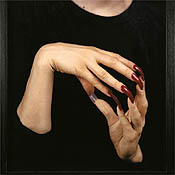
This photograph, taken by Janine Antoni, shows a woman whose nails appear to have “grown into” each other. This photograph relates to the weeks topic of visual unity because it creates a sense of harmony through the use of continuation in the nails. I think that it is an effective piece, because the continuation draws the viewer to the unusual subject.


 This piece by Allora and Calzadilla involves a hippo sculpted out of mud, a man, and a daily newspaper. I think the conceptual unity present in this piece lies in the actions of the everyday and how even these normal, mundane actions can affect everyone and everything . The man is reading a newspaper, a very mundane and everyday act. The hippo looks as if it is taking a nap under the sun, a simiarly everyday occurence for a hippo. I like this piece because I think that the position of these two figures together suggests a coexistence; it gives the message that man and nature can function side by side.

