Showing posts with label Artist Balance. Show all posts

Sunday, April 19, 2009

Richard Serra


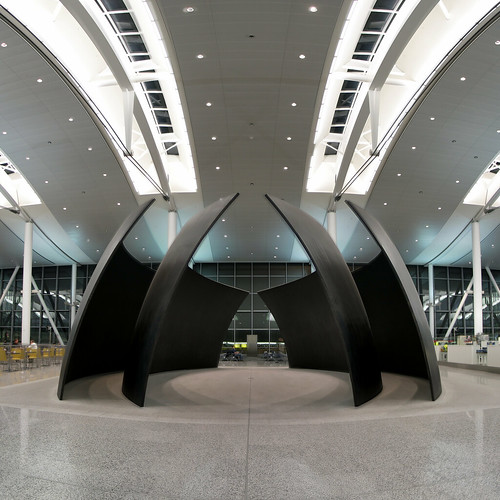
This work by Richard Serra called "Torqued Ellipse VI" is a great example of balance in art. There seems to be a horizontal symmetry line on the piece, yet when looking closely one can notice that it is not perfectly symmetrical. Yet the different values of the pice, the grayness of the floor, darkness of the piece itself and whiteness of the ceiling, create balance. Th fact that this whole piece is created in soft curves also creates balance as there are no hard lines that break its harmony. I feel like its balance also comes from its simplicity, it is a minimal design yet beautiful from its soft curves. I guess the softness of the design also contrasts and balances out the hardness of the steel used to make it.

Wednesday, April 8, 2009

Artist Balance

The artist Richard Misrach makes a very effective use of balance to convey the feeling in this photograph.  The calm and peaceful background makes a contrast to the diving board and swimming pool which give the viewer a feeling of destruction or sadness.  Both the contrast and the colors create a sense of balance.  I like the simplicity of the photograph and the way it seems to convey a more complex idea.  

Thursday, April 2, 2009

Richard Misrach: On the Beach

This photograph by Richard Misrach expresses balance in simple terms. The rectangular area of the photograph is almost exactly evenly divided between water and sand, with an area in between that is not quite one or the other. I like the peaceful feeling expressed in this photo, through the calm waters and empty beach. I also like that he manages to express peace without using the horizon as it is typically seen, in a perfectly horizontal line across. He shifts the perspective and uses a diagonal line, which often implies motion, to express perfect calm and tranquility. Furthermore, the soft colors also suggest peace, while complementing each other and adding to the general balance of the photograph.

Tuesday, March 24, 2009

Richard Serra-Tilted Spheres


In this sculpture, Serra creates balance that is very symmetrical. Both sides of the sculpture share an equal weight, and I feel that this balance can evoke feelings of peace and tranquility. What I also find interesting is the consideration of open/negative space in creating such symmetrical balance. I feel that the interplay between open space and the space occupied by the sculpture is very aesthetically attractive. The open space, I feel, evokes a sense of freedom--an unrestricted ability to move through the space. However, there is also an element of imprisonment at the same time. The sculptured pieces are in a tilted position, and this could imply that the walls of the sculpture could fall in to each other, which trap you as you attempted to explore the sculpture. I think Serra achieves an interesting harmony by playing with the ideas of stability and instability.

Wednesday, March 18, 2009

alexander calder

Alexander Calder is an American sculptor and artist best known for his creation of the mobile — a sculpture exploring balance as an artistic technique. Other sculptures of his, while not mobiles by definition, also focused on the idea of balance in abstract art. I particularly like this piece by Calder. It creates the same emphasis of balance, but in two dimensions. The piece is clearly balanced, divided into two evenly "weighted" halves. He conveys weight not with the use of 3D mass, but instead color and density of lines.

Richard Serra

This sculpture by Richard Serra, entitled Vortex, epitomizes his search for the line between balance and disorder.  The steel sheets are monolithic, and tower over their surroundings in a way that is almost precarious.  Looking at scale alone, this piece creates a conflict on a grand size.  Overall, the essences of this piece is organic, seeming to interact with itself in a dynamic, continuous way.  The chaotic notion evoked by the dynamism of the upward-spiraling faces is balanced, or at least contrasted when the sculpture is seen from the inside.  From this view, it is clear that the individual units are not in fact precarious perched on each other, but mathematically placed to ensure their stability.  The heptagon formed by the meeting of each sheet is seemingly precise.  This oculus onto the skies give this piece a heavenly importance (much like the oculus in the Parthenon).  

Richard Misrach's "Flooded House (chair) Salton Sea (1985)"


I really enjoyed Richard Misrach's photography because most of it was socially conscious without necessarily having journalistic intentions. He prefered to compare his photographs to history paintings--capturing the image of a particular moment in time. For instance, this photograph falls in line with his theme of capturing an instance of human interference with a landscape--in this case, a flood that resulted from the "engineering disaster" that was the manmade Salton Sea in California. Besides its social consciousness, though, this picture demonstrates balance through its use of similar colors and its repetition of lines (such as in the windows and the wooden boards. He does use a lack of balance to bring attention to the asbestos hanging down in front of the picture, which adds to the depth. However, because the asbestos is not in focus, the viewer moves from that focal point to the rest of the room which is in focus.

Tuesday, March 17, 2009

Wunderlampe

It is easy to find balance in Pipilotti Rist's work, Wunderlampe, through the symmetry of this piece. The identical chairs sit on either side of the lamp, which cuts a vertical line through this image. This symmetrical image's feeling of balance is thrown off by the shadows of the chairs and lamp cast onto the wall. I like the simplicity of this piece, but also enjoy the feeling of uneasiness brought to this work by the shadows.